Books, Books and More Books

‘God Calls Everyone’ – Revd. Canon Derek Walmsley

One of the challenges of any form of studying is the number of books on your reading list. Even for those of us who love reading this can be a huge task.

Every challenge comes with opportunity and for me, the breadth of my reading for this study has led me to books that sit outside my usual faith stream. I came to faith and have remained in an Independent Pentecostal Church setting for almost 50 years. I am comfortable with the authors I know who come from a similar faith background but during the last five years of study, I have benefited from reading books from different streams of the Christian faith.

This week I have been particularly blessed by Revd. Canon Derek Walmsley’s book ‘God Calls Everyone’(1). I particularly enjoyed the readability of the book, the touches of humour and the meaningful personal and practical examples scattered throughout the text. 

Revd. Canon Walmsley is clearly a person steeped in the bible but with an ability to present his theology in a clear, simple way. I was particularly touched by the grace he applies when discussing areas where views may differ such as the infilling of the Holy Spirit and interpreting the book of Revelation. I have much to learn when talking to people whose faith position is different to my own.

The book takes readers on a journey through the whole bible narrative, exploring vocation and how God calls everyone. Once we understand the pivotal concept that God has a plan and amazingly He invites us to get involved in what He is already doing, we become less preoccupied with ourselves and what our individual plan might look like. As well as encouraging us to take our eyes off ourselves, the author creates a wonderful sense of purpose as we realize God wants us to be involved in His great plan and there is a place for everyone.

The book re-centres our lives on being a follower of Jesus before we are anything else.

There were definitely some ‘ouch’ moments in this book as my myths about vocation were gently but clearly challenged. There we also some beautiful poignant moments where the reality of the simplicity of God’s calling permeated my heart in a very special way. So thank you Revd. Canon Walmsley(2).
References

(1)Published by Authentic Media Ltd. 2020.

(2) Revd. Canon Derek Walmsley is the Diocesan Director of Ordinands & Vocations for the Anglican Diocese of Leeds and a residentiary canon of Wakefield Cathedral
What are the ‘Four Voices of Theology’?

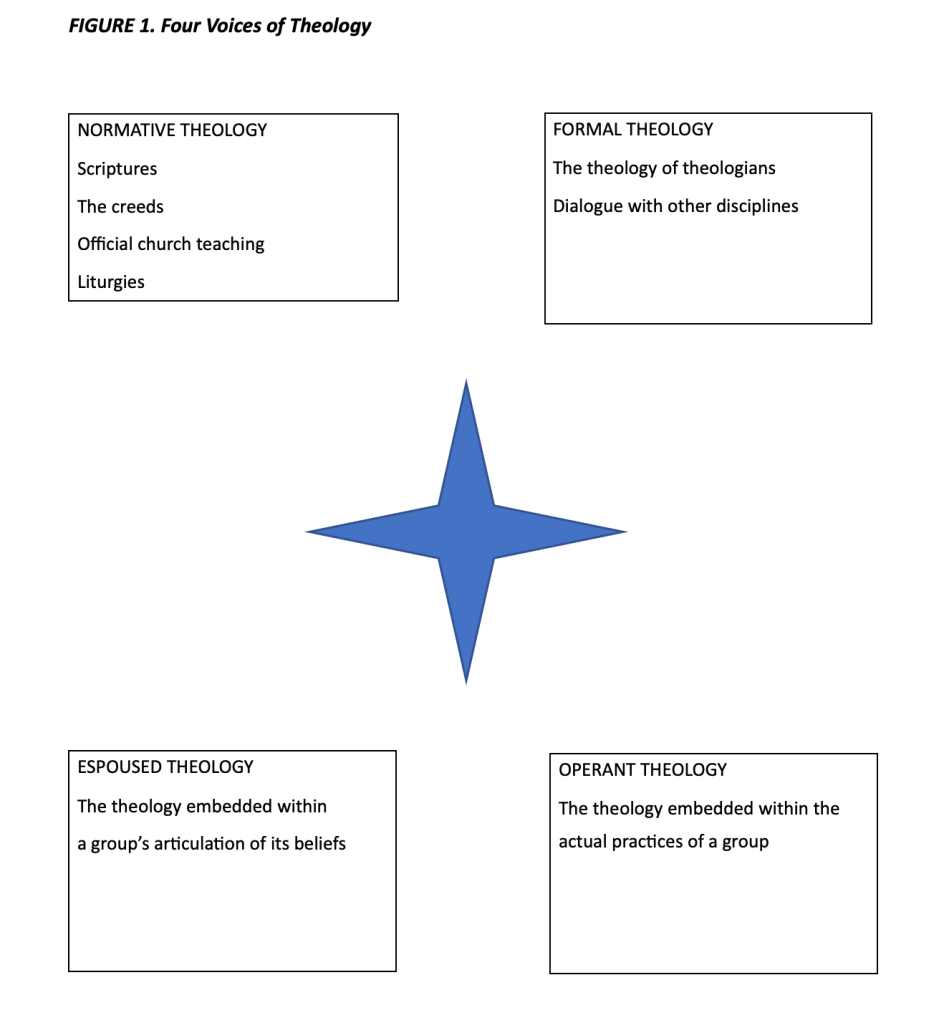
The ‘Four Voice of Theology’ (Figure 1)  is a reflective tool developed by the Action Research: Church and Society (ARCS) team while working with churches, Christian NGO’s and organisations in the UK. In the book ‘Talking About God in Practice (Cameron, et al., 2010) the ARCS team discuss the four different theological voices that can be heard when the practices of the church and individual Christians are discussed.  The four voices are normative, formal, espoused and operant. Whilst four voices can be identified, in reality, they are often combined and happening concurrently within the everyday practices and narratives of church life. This approach (a typology) helps us to understand the connection between theology and action. The four voices act as a working tool that helps identify, within the lived practices of our faith, which of the four voices are speaking. The espoused and operant voices are at the level of practice, the normative and formal at the reflective level (Cameron, et al., 2010, p. 53).

The four voices are:

Operant Theology

This is how people act and embody faith (Ward, 2017). It is likely that within my study this voice will be heard as the members of the Learning Hub study the stories shared by members of the congregation. This theology is complex and needs to be discovered by the Learning Hub members themselves as it is often viewed as ‘just something we do’ . This study seeks give attention to and reflect on these everyday ways of believing to reveal their theological voice

Espoused Theology

This is the ARCS team’s term for the way theology is spoken of by the members of the congregation. The researchers found that there was a tendency for there to be differences in what was ‘spoken’ (espoused)  and what was ‘seen’ in practice (operant). This will be an interesting area of study as we look to see if there are subtle or obvious differences between what people say about faith and work and how that is lived out in practice. Espoused theologies come from somewhere. It will be interesting to explore the sources that inform our espoused theology in an Independent Pentecostal church setting.

Normative Theology

This voice is helpful in identifying those sources of instruction and guidance adopted by congregations and individuals. Is it scripture or our own form of liturgy? Pentecostal churches have their own expression of liturgy, for example, the form of our public worship which is manifested in expressive worship and prayers. The relationship between the normative voice of the congregation and the espoused theology of individuals will be considered within this study.

Formal Theology

This voice is about the contribution academic or professional theologians bring to our understanding of the practices and life of the church. It is proposed by Cameron et all (2010) that this voice is deeply entwined with the other three theological voices suggesting that espoused and normative theology draws on formal theology. An example would be ministers preaching drawing on academic study or an individual drawing on information received at a previously attended theological seminar.

So why explore the Four Voices of Theology? 

In this study I am including the Four Voices reflective tool alongside the Appreciating Theology model as a way of ensuring theological reflection is embedded within the study. 

Will it help? I do not know if it will or not, we shall see as the study progresses. The concept of theological reflection is important as it creates a space for us to start to understand and articulate the theology of our lived faith. It can shine a light on areas of our faith, bring new understanding, cultivate theologically-grounded practical wisdom and refresh our practice of living our faith in everyday life. In our Christian walk there is always more to be understood that we might know more of Christ and represent Him well in our daily lives. 

Cameron, H., Bhatti, D., Duce, C., Sweeney, J. and Watkins, C. (2010) Talking about God in practice. London: SCM Press.
Ward, P. (2017) Introducing Practical Theology – Mission, Ministry and the Life of the Church. United States of America: Baker Academic.

Let’s Learn

A huge thank you to everyone who gave their time to tell their stories during the ‘Let’s Chat’ stage of the Appreciating Theology research study. We had over 30 people sharing their amazing stories about faith and work. The stories were a delight to hear and full of rich information for the study. The stories were recorded and have been anonymised and transcribed into documents. A number of these are ready for use in the next stage of the project called ‘Let’s Learn’ and the remaining transcribing will be completed by the end of October 2022.

Where are we now?

This research study has four stages and we have now entered stage 2 of the study called ‘Let’s Learn’

The diagram below has been previously shared in the ‘What is Appreciating Theology?’ section of the Blog. This is a diagrammatical representation of the research model I have developed called ‘Appreciating Theology’. This stage involves the development of a Learning Hub to explore the contents of the anonymised transcripts. 

The Learning Hub was established in August 2022 and we have met twice at the time of writing. There are 9 people in the Learning Hub recruited from the congregation of Kingdom Culture Church who will co-work with me for the next 12-18 months. This was an amazing response and there are a number of people not involved in the Learning Hub directly but who regularly enquire about our progress. 

The Let’s Learn stage is really interesting, it is where we get to look closely at the Let’s Chat discussions in an anonymised format and pull out some key findings and insightful comments from those who took part. The richness, wisdom and insight found within people’s stories never cease to amaze me. Christian believers are theological without even realising it as they articulate how they walk with God every day of their lives, how they apply the word of God and Christian principles and values in every area of their lives. 

As I listened to the recordings of the stories I was reminded of this bible verse:

Colossians 3:23-24 (New Living Translation)

23 Work willingly at whatever you do, as though you were working for the Lord rather than for people. 24 Remember that the Lord will give you an inheritance as your reward, and that the Master you are serving is Christ. 

Many people told story after story of how they were beginning to recognise they were serving God in their everyday lives and particularly in the area of work. Serving not their earthly boss but they were responding to a higher Master, Jesus Christ.

From this information, we are looking to identify key themes but also to create some visionary statements about our faith and work that are aspirational but also practical. The actions that support achieving these visionary statements will be developed in the Let’s Do stage of the study.

We will also be including a theological reflection model called the ‘Four Voices of Theology’ (Cameron, et al., 2010) which is explained in the relevant section of this Blog. 

This type of research is in my view the best research as we have no idea where the journey will take us or what the journey will produce. I imagine it as going on an expedition with friends, the exact destination is unknown, we must see where the information takes us and change direction as and when required. As a researcher, it is exciting but also a little risky to launch out into the unknown. You have to trust the process, the information and the insight of the Holy Spirit. Of one thing I am quite convinced, our church will never be the same again having engaged in a research study such as this. People are thinking and talking about their calling, what their ‘frontline’ is, where God moving in their work and how can they engage with God’s plans on a daily basis. This is what whole life discipleship looks like. 

References

Cameron, H., Bhatti, D., Duce, C., Sweeney, J. and Watkins, C. (2010) Talking about God in practice. London: SCM Press.

Mission or Mystery?

As a Pastor people often ask me how can I find my purpose in life?, what is my mission in life?. It can seem like a mystery that for some, remains unsolved for years which is sad and as we all want to live a life of purpose.

God has been very transparent in sharing his mission with us, his ‘Missio Dei’. This wonderful Latin Christian theological term has a depth and power of meaning that no English translation can easily capture. I find the words of Paul Avis helpful  ‘Missio Dei speaks of the overflowing of the love of God’s being and nature into God’s purposeful activity in the world’ (Avis, 2005, p. 5). These words clearly imply that God is already at work in the world and I would suggest our mission in life is to join in with his mission. God’s desire has always been to restore this world and all the people in it back into relationship with him. God sent Jesus into this world as part of his Missio Dei and God desires that we, as believers, share his heart for the world and those in it. We become co-workers in God’s mission, what a privilege, we co-work with God to bring about his Kingdom here on earth. I like to think of it as being an agent on God’s assignment but that could be because of my early unfulfilled career desire to be an MI5 agent!  

Our mission is not hidden, it’s not a mystery we spend all our lives trying to solve, it is in clear sight for those who want to receive it. 

Participating in Missio Dei is not for the faint-hearted, it brings its own kind of challenges. It disrupts our lives, it causes a shift in priorities but it is an amazing place of fulfilment. It is out of this mission our ministry flows. We are all called to ministry, as we join in with what God is already doing here on earth we are ministering. Ministry is serving, Jesus was clear he did not come to be served but to serve (Mark 10:45). That service to others often takes place outside of the four walls of church and definitely takes place every day of the week not just on a Sunday. Our ministry might be serving our family, friends, peers, work colleagues, the community or fellow students.

As the church, and by that I mean the people of God, recognise that they come together as the ‘gathered’ church on Sunday to be the ‘scattered’ church the rest of the week then amazing things will happen, lives will be changed, families and communities will be transformed by the power of the Holy Spirit. Missio Dei visible in this world.

For me, this quote describes beautifully the impact of the scattered church participating in Missio Dei: 

‘The missional church…does not create sanctified spaces into which unbelievers must come to encounter the gospel. Rather, the missional church disassembles itself and seeps into the cracks and crevices of a society in order to be Christ to those who don’t yet know Him’

 (Frost & Hirsch, 2013, p. 25)

Some reflections for the days ahead:

Missio Dei, it is here, it is now – it is right in front of us.

Missio Dei is present and active in our world – it is freely accessible.

Missio Dei requires a response from those believe – it is our opportunity to co-work with God in his Kingdom.

How amazing that God chooses us to participate in his Missio Dei every day of our lives wherever we find ourselves.

Speak soon

Jean

References

Avis, P. (2005) A ministry shaped mission London, T & T Clark International.

Frost, M. and Hirsch, A. (2013) The Shaping of things to come. United States of America, Baker Books.

Let’s Chat

Let’s Chat is the first stage of our research project ‘Appreciating Theology’. It is exactly what it says – an opportunity for two people to have a chat about their work and faith experiences. The chat focusses on the amazing stories we all have but maybe have never shared with anyone. Sometimes we don’t recognise the value of our stories and it is not until we share them their incredible value is recognised.

Storytelling is an important part of bringing change in the church as stories are routed in real experiences and encourage involvement in the change process (Roberts, 2017). True stories lift our vision for the future and are an ‘instrument of faith’ as well as a method of communication (White, 1986). Stories, in the form of parables, were of course used by Jesus to explain the Kingdom of God so we have a great example to replicate.

Let’s Chat is, in terms of the research model Appreciative Inquiry, a ‘discovery interview’. (Hammond, 2013). I love the idea of discovering things about people but I am not so keen to use the word interview as it reminds me of job interviews, success or failure, pass or fail. This discussion is none of those things, everyone’s experience is of equal value and everyone’s work matters.

The chat takes place through a lens of appreciating what is good about those experiences. The good things from the past and the hopes and dreams for the future. The Let’s Chat session has a Storyteller and a person asking some semi-structured questions to help the Storyteller focus on the area of faith and work. The person asking the questions is called the Host. A Host is the attentive friend, listening to every word and encouraging the Storyteller by using words and body language that lets them know what they are saying is important. A Let’s Chat session last on average 30-45minutes with some introductory chat followed by nine questions. The questions are shared with the Storyteller at least a week before the Let’s Chat discussion to allow time to reflect and recall stories of past experiences.

Here are two examples of the questions:

Q. Can you describe a time when you have felt good about the work that you do?

What was it about that situation that made you feel good?

Q. God has given us all skills in order to help one another (or others), describe your greatest skills, attributes and abilities.

Can you give some examples of when you have felt your skills, attributes and abilities have been used in your work? 

Can you describe how that made you feel?

The chat is recorded via ©Zoom so that it can be transcribed and shared during Stage 2 of the project called ‘Let’s Learn’. The Storyteller is known by a pseudonym throughout the story and within the transcript. The information is shared from the perspective of it is rich information that is valuable and it must be treated with the respect it deserves. It has been deposited to us as a  gift and should be appreciated as such.

The project is supervised by two staff from  York St. John University as part of the Doctor of Ministry programme. This means that the research project and particularly the handling of the Let’s Chat information has to comply with strict ethical guidelines adding a further level of care and protection  to the information people share. Everyone who wants to participate in a Let’s Chat session is given a Participant Information Leaflet and is then asked to sign a consent form to participate. This is all part of the arrangements to treat you and your information is a respectful and appropriate way.  

The Storyteller and Host can swap roles and a second ©Zoom meeting is arranged to capture the stories of the Host who has now become the Storyteller.

The stories are fascinating and are so interesting, I love this part of the Appreciative Inquiry process. I learn so much about people and their lives, their stories weave a beautiful tapestry of their lives and experiences. 

It is a privilege to be a Host, it is simply being the attentive friend, an encourager and a good listener. If you would like to know more about being a Host then you might find this training session I recorded with our first cohort of Hosts helpful: https://drive.google.com/file/d/1ELfCEOTpj7x2LrMF9orX9TcvpUFy8pSf/view?usp=sharing

It is not too late to participate in a Let’s Chat session, go to the Contact tab on this Blog and email me to let me know you are interested. I will send you some information and you can decide if you wish to go ahead with a Let’s Chat session, there is no obligation to go ahead it is entirely up to you.

Thank you to those who have already agreed to participate in a Let’s Chat session. Your contribution to this important project is greatly appreciated.

Speak soon 

Jean

Hammond, S. A. (2013) The Thin Book of Appreciative Inquiry. Bend Oregon USA, Thin  Book Publishing Co.

Roberts, V. S. (2017) The Power of Story to Change a Church. Grove Leadership Cambridge, Grove Books Limited.

White, W. R. (1986) Stories for Telling: A Treasury for Christain Storytellers Minneapolis USA, Augsburg Publishing House.

What is ‘Appreciating Theology’ ?

Appreciating theology is the title of our church project where we will be exploring faith and work. The project is also a university research study. The term ‘appreciating theology’ reflects the type of research approach I am using for the project. The research approach has two parts. The first is something called appreciative inquiry (AI), which is a form of action research (Cooperrider, et al., 2008). The clue is in the name – this type of research ends with actions. The project is not purely theoretical, it will have actions, things we will put in place in the church to help us in the area of our faith and work as part of our whole-life discipleship approach to Christianity. AI is a specific form of action research, unlike other forms of action research it does not focus on problems to be fixed. AI is a positive approach to situations that concentrates on an individual’s positive experiences that are shared by telling their stories. AI asks people to share positive memories from the past and to describe their hopes and dreams for a better future. This approach reminds me of this scripture:

Finally, brethren, whatever things are true, whatever things are noble, whatever things are just, whatever things are pure, whatever things are lovely, whatever things are of good report, if there is any virtue and if there is anything praiseworthy — meditate on these things. ~ Philippians 4:8 NKJV

The appreciative inquiry model has five stages, which uses terminology we maybe would not use in our everyday life. To help make this model less academic and more user friendly, I have renamed the stages using terms I hope everyone will recognize and understand:

  1. Let’s Chat
  2. Let’s Learn 
  3. Let’s Do 
  4. Let’s Reflect 

Each of these stages are explained within this Blog. 

I have combined the AI model with something called theological action research, as this is a study that has theology at the centre. Theological action research (Cameron, et al., 2010) was developed as a way to ensure that reflection was completely theological. Theological action research uses something called the ‘Four Voices of Theology’ to assist in theological reflection.  We will be using the Four Voices model to reflect on the information gathered during the Let’s Chat stage of the project. 

This would be described as a ‘practical theology’ research project. Practical theology looks at theology in our everyday activities.

For the purpose of this research project:

Appreciative Inquiry + Theological Action Research = ‘Appreciating Theology’

The diagram below shows how all this comes together as a model I have called ‘appreciating theology’.

I am sharing the detail of the model for those who like to know the specifics, if you participate in the study, you don’t need to know this level of detail. We will work through the stages of the model together. You can be involved as much as you want within the project ranging from doing one Let’s Chat session, which lasts approximately 45 minutes, to being fully involved in all of the four stages of the model, which will take a couple of hours each month for approximately 12 to 18 months for the project to collect meaningful information.

 I am looking for a number of people to share their stories about faith and work. If you would like to be involved, please contact me via this blog, if you  go to the Contact tab you can email me. There are no right or wrong answers, everyone’s story is of value and of equal status, should you be a paid employee a carer, homemaker, a foster carer, or retired. If you would like to know more detail about the Let’s Chat session , please click this link which takes you to a recording of an Appreciative Inquiry briefing session I held recently with members of Kingdom Culture Church. 

https://drive.google.com/file/d/1dpwp8UGaKQ5R6yQ_Lik9yh5-KDF8pITR/view?usp=sharing

The briefing session explains the project aim, background and the Let’s Chat stage in a little more detail. There is still time to join us as we embark on this exciting journey together. 

Speak soon

Jean

Cameron, H., Bhatti, D., Duce, C., Sweeney, J. and Watkins, C. (2010) Talking about God in practice. London, SCM Press.

Cooperrider, D. L., Whitney, D. and Stavros, J. M. (2008) Appreciative Inquiry Handbook: For leaders of change. Second ed. USA, Crown Custom Publishing Inc

Why Faith and Work?

I have already shared my personal story and details of my journey as a Christian called to both a secular job and a role within the life of the church. Within my story, I have described some of my thoughts and questions about a potential sacred-secular divide in the area of faith and work. 

I realised I was not alone in my thinking when I read a 2009 survey report conducted by the London Institute of Christianity called ‘Apprentice 09’ (Care, 2009). The survey found that 59% of the 2,859 respondents found work to be the most challenging context to be a disciple for Christ. The most challenging finding within the study for me as a church leader, was that 62% of the respondents in full-time paid employment experienced little, not much  or no help or preparation from the life and ministries of the church, to deal with the issues they faced at work. 

This set me on a journey, was this correct?, did other people feel this way and if so why?, what should the leaders of a church be doing about this? My further reading in this area confirmed ‘Houston – we have a problem’.

It would have been easy to read a few more books, listen to a couple of podcasts and put in place some of the recommended actions to support members of the congregation in their work and faith journey. This felt inadequate as I truly believe each Christian has the experience, wisdom and insight to bring their thoughts and views to a table of discussion and innovation. This is the living reality of ‘practical theology’, real people exploring faith in their own lives in practical ways. This research study creates a space for those discussions to take place with members of our congregation and to build a discipleship pathway that embraces the whole of our lives.

In reality, 98% of the gathered church will spend 95% of their lives outside of the church living as the scattered church.  We all have 168 hrs a week available to us, of those 168hrs we are awake for about 120hrs. Most of us spend no more that 10hrs a week in church activities, for some it is much less. If we estimate we have 110hrs remaining, those remaining hours are spent elsewhere ie at work, in the home, with family and /or friends. For a lot of us, many of those hours will be spent undertaking some form of work – paid, unpaid, in the home, the community or a workplace. Work is significant, navigating it well, feeling equipped as a Christian and understanding its place in our theology is important.

The novelist and playwright Dorothy L. Sayers, one of my favourite mystery writers, was also a Christian apologist. She had a very forthright view on work and the Christian faith:

In nothing has the Church so lost Her hold on reality as Her failure to understand and respect the secular vocation. She has allowed work and religion to become separate departments, and is astonished to find that, as a result, the secular work of the world is turned to purely selfish and destructive ends, and that the greater part of the world’s intelligent workers have become irreligious or at least uninterested in religion…. But is it astonishing? How can any one remain interested in a religion which seems to have no concern with nine-tenths of his life?’ (Sayers, 2004, p. 138)

Sayers is making a wider point here which is that by not giving attention in the Christian faith to work, we are failing to present a gospel to non-believers that addresses the whole of their lives. Another reason why we need to ensure that the area of work is fully embraced in our gospel message.

Work is linked to our understanding of vocation, calling, ministry,  whole-life discipleship and of being a ‘priesthood of all believers (1 Peter 2:4-5 NIV). Such is the centrality of work to our Christian faith that it is worthy of further exploration through this practical theology research study.

So who best to talk about and share their experiences of work and faith? – you.

Who can inform the thinking of the leadership team, help develop meaningful resources and activities as the gathered church to equip people to be the scattered church in the area of work? – you.

By participating in this study you are helping to create a legacy, a legacy for those currently working and for those generations coming up behind us who will enter into work.

I look forward to journeying with you in this important area of faith and work.

Blessings

Jean

References

Care, B. (2009). Apprentice ’09’ Survey – Full Results. London, Spring Harvest and The London Institute of Contemporary Christianity.

Sayers, D. L. (2004) Letters to a Diminished Church: Passionate Arguments for the Relevance of Christian Doctrine,. Nashville, Thomas Nelson.

My Story

Anyone else find it difficult to write about themselves? I can hear my Mum telling me not to brag and my own inner critic asking “and who do you think would be interested in your story”? 

All our stories are special, are of value and can inspire others. This blog is all about stories, stories that emerge from sharing our life experiences about faith and work.

Work.

My own work story started in 1973 when I started work as a Cadet Nurse. I entered nursing as a 16yr old with one G.C.S.E. not the required four and miraculously qualified as a State Registered Nurse in 1978. During that period of my life another story started, that of my relationship with God as I became a Christian in 1974. From that moment I felt I was walking two separate paths, my work path and my faith path. I am not sure why that was, could it have been the emphasise on the gathered church on a Sunday,  the importance of church ministry, the supremacy of what I did in church or the inspiring but limiting preaching on ‘calling’ and ‘ministry’?,  I am not sure,  but I felt as though  I was two different people – the work me and the church me.

I loved my work, I specialised in Intensive Care and became a senior nurse in this specialty, leading and training many staff over the 17 years spent in this specialty. I then moved into senior leadership working at regional and national level. I loved what I did on the good days and the bad days. I felt had been given the skills, gifts and abilities to do this work, dare I say it by God.

I went on to gain an MBA in Leading Strategic Change, a LL.M in medical law and a number of leadership, management and teaching qualifications. I discovered I loved teaching in universities and other professional and academic settings. Was this a God calling or was it a distraction to draw me away from His plan for my life? A question I pondered many times and never really found the answer in a career spanning 38 years.

The Church.

My other life story existed in parallel within the church. I served wherever I could, responded to altar calls to follow God with my whole life many times and juggled church activities with the busyness of a demanding career. I have held a variety of leadership roles in Independent Pentecostal Church settings for over 35 years and still look back and see two paths, running concurrently but nevertheless separately through my life.

My Double Life.

I have retired from formal NHS work, but once a nurse always a nurse. I still get frequent text messages asking me to explain medicines, blood and scan results, and interesting photos of rashes or wounds not for the faint hearted. 

It is only now I have had the space to reflect on my inner feelings of having lived a ‘double life’. I have loved both my ‘secular’ work and my ‘sacred’ work, as a Pastor, doctoral researcher, business owner and consultant to the NHS. I continue to battle this thought that my ‘secular’ roles are less important than my ‘sacred’ roles. I have been challenged many times over the years to decide if I am called to be a ‘priest’ or a ‘king’, am I called to sacred priestly work or secular work?  It was always implied that the sacred calling was a higher calling and the things I did in my working week were good but not in any way equal to my church role.

Questions, Questions, Questions.

Could that be right? Do the things we all do on a Sunday or church activities in the week have greater value to God than the things we do as work i.e. paid or unpaid, the rest of the week? Where is God in our work, where do faith and work come together, what does the bible have to say on this? These questions have led me to my current studies as a doctoral researcher in practical theology as part of the Doctor of Ministry programme at York St. John University. Even the words ‘doctoral researcher’ make me feel like an imposter, who is this person who thinks she can enter into the world of academia, especially in theology, a subject she has never studied at university, and find answers to her questions?  

How do I combine my role as a pastor and a researcher? Will anyone be interested in the study? How will any of this help our church attendees in their faith journey and other pastors, teams and members of Independent Pentecostal Churches? It seems like I am finding more questions as  I listen and talk to other Christians, but such is my passion for people to know their faith and work are both significant, I am ready to invest the time and effort to hear and explore these things through my story and the stories of others. With the help of the Holy Spirit and insight from the Word of God, we can go on this journey together and create an environment where faith and work are valued, recognised and supported by the church.

That’s my story, now I want to encourage you to share your story with me as part of this research study. The study is all about storytelling, your stories have within them amazing insights and experiences of faith and work and I can’t wait to hear them.

Speak soon 

Jean

Welcome to this Blog

Welcome to this blog, thank you for taking the time to drop by. I hope you find it informative but more than that, I hope you find it affirmative and transformational as we take this journey together into theology and research in the area of faith and work.

My audience is those of us who call Kingdom Culture Church their home and possibly others who have an interest in our journey. As an Independent Pentecostal church, taking a formal research approach to explore our faith and work is unusual and might be unchartered territory for many. I am confident that what we all have to contribute through our stories is worthy of such a study and will bring out valuable information that can help us shape our future.

As a church, we fully subscribe to ‘whole-life discipleship’ and this project will inform one of the key areas of our discipleship, faith and work. From this project, we will develop resources and teaching to help us all in this important area. 

By work, I mean any paid or voluntary form of work, that may take place in a workplace, the community or your own home. I will sometimes refer to the place your work takes place in as your ‘frontline’ which is a term used in many of the excellent materials on faith and work developed by the London Institute of Contemporary Christianity 

This blog will provide the following:

  • an explanation of the background to the research project ‘Appreciating Theology – Faith & work’
  • why this journey is important to me
  • how it can make a difference to you, to Kingdom Culture Church and other Independent Pentecostal Churches
  • how valuable your story is in this project
  • what it would mean to be involved in this project

The project is a research study that forms part of the Doctor of Ministry programme at York St. John University and is supervised by Professor Reverend Andrew Village and Dr Mark Dawson.

I recognise it is not common for a church such as ours to be involved in a formal research study but this project is an amazing opportunity to capture the significant stories of faith and work in the lives of us all. You and your stories are important, unique and can help shape our future.

If you are interested in knowing more about the project then keep checking in with me via this blog. I would love you to join me on this adventure, together we can explore the important area of faith and work.

Speak very soon

Jean