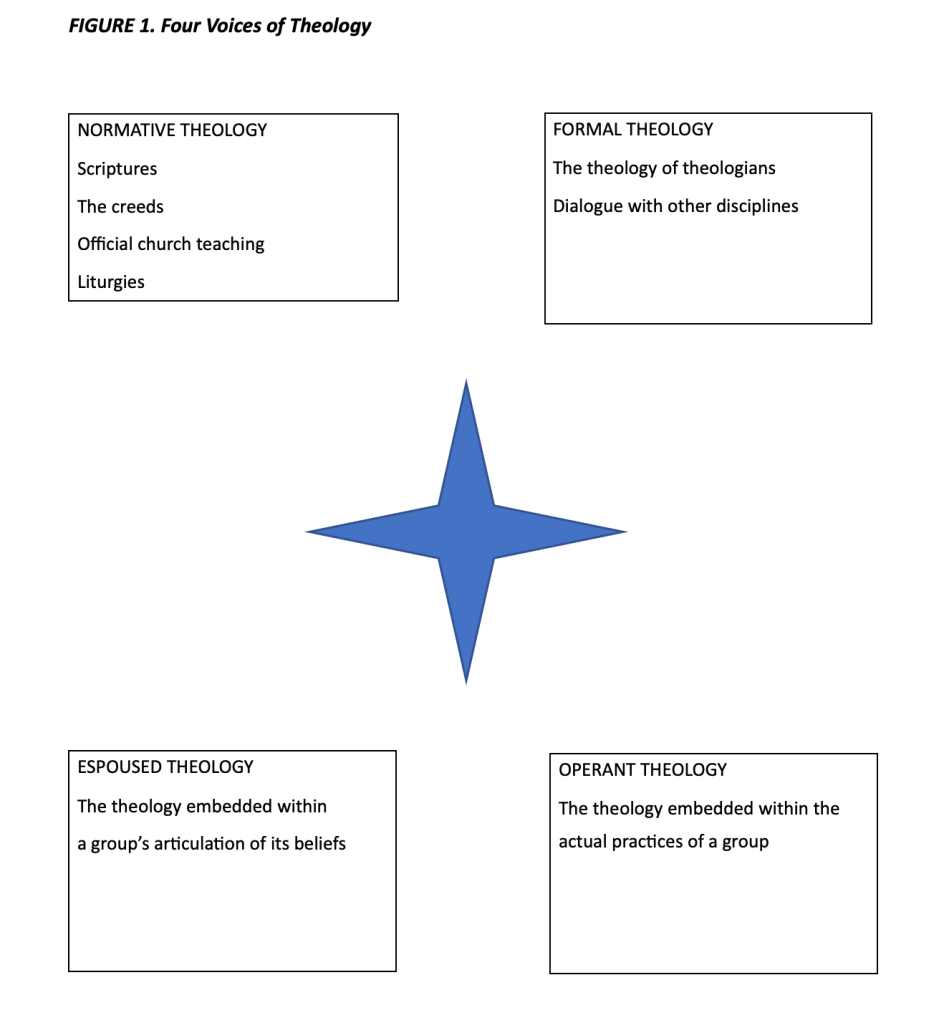
The ‘Four Voice of Theology’ (Figure 1) is a reflective tool developed by the Action Research: Church and Society (ARCS) team while working with churches, Christian NGO’s and organisations in the UK. In the book ‘Talking About God in Practice (Cameron, et al., 2010) the ARCS team discuss the four different theological voices that can be heard when the practices of the church and individual Christians are discussed. The four voices are normative, formal, espoused and operant. Whilst four voices can be identified, in reality, they are often combined and happening concurrently within the everyday practices and narratives of church life. This approach (a typology) helps us to understand the connection between theology and action. The four voices act as a working tool that helps identify, within the lived practices of our faith, which of the four voices are speaking. The espoused and operant voices are at the level of practice, the normative and formal at the reflective level (Cameron, et al., 2010, p. 53).
The four voices are:
Operant Theology
This is how people act and embody faith (Ward, 2017). It is likely that within my study this voice will be heard as the members of the Learning Hub study the stories shared by members of the congregation. This theology is complex and needs to be discovered by the Learning Hub members themselves as it is often viewed as ‘just something we do’ . This study seeks give attention to and reflect on these everyday ways of believing to reveal their theological voice
Espoused Theology
This is the ARCS team’s term for the way theology is spoken of by the members of the congregation. The researchers found that there was a tendency for there to be differences in what was ‘spoken’ (espoused) and what was ‘seen’ in practice (operant). This will be an interesting area of study as we look to see if there are subtle or obvious differences between what people say about faith and work and how that is lived out in practice. Espoused theologies come from somewhere. It will be interesting to explore the sources that inform our espoused theology in an Independent Pentecostal church setting.
Normative Theology
This voice is helpful in identifying those sources of instruction and guidance adopted by congregations and individuals. Is it scripture or our own form of liturgy? Pentecostal churches have their own expression of liturgy, for example, the form of our public worship which is manifested in expressive worship and prayers. The relationship between the normative voice of the congregation and the espoused theology of individuals will be considered within this study.
Formal Theology
This voice is about the contribution academic or professional theologians bring to our understanding of the practices and life of the church. It is proposed by Cameron et all (2010) that this voice is deeply entwined with the other three theological voices suggesting that espoused and normative theology draws on formal theology. An example would be ministers preaching drawing on academic study or an individual drawing on information received at a previously attended theological seminar.
So why explore the Four Voices of Theology?
In this study I am including the Four Voices reflective tool alongside the Appreciating Theology model as a way of ensuring theological reflection is embedded within the study.
Will it help? I do not know if it will or not, we shall see as the study progresses. The concept of theological reflection is important as it creates a space for us to start to understand and articulate the theology of our lived faith. It can shine a light on areas of our faith, bring new understanding, cultivate theologically-grounded practical wisdom and refresh our practice of living our faith in everyday life. In our Christian walk there is always more to be understood that we might know more of Christ and represent Him well in our daily lives.
Ward, P. (2017) Introducing Practical Theology – Mission, Ministry and the Life of the Church. United States of America: Baker Academic.
 Appreciating Theology
One thought on “What are the ‘Four Voices of Theology’?”
Comments are closed.